Brian Donohue

About

“We are what we pretend to be, so we must be careful about what we pretend to be.” ― Kurt Vonnegut

50 Million Potentially Vulnerable to UPnP Flaws

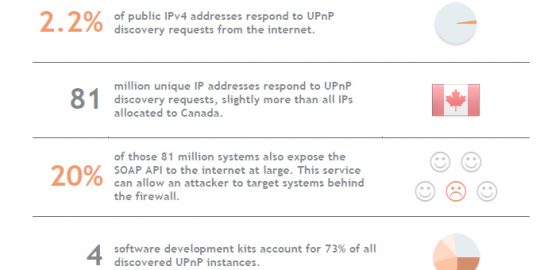
In a project that found more than 80 million unique IP addresses responding to Universal Plug and Play (UPnP) discovery requests, researchers at Rapid7 were shocked to find that somewhere between 40 and 50 million of those are vulnerable to at least one of three known attacks.


Court: Government Need Not Justify Warrantless Data Requests

A Virginia appeals court on Friday denied a right-to-access order filed by the Electronic Frontier Foundation and the American Civil Liberties Union on behalf of Icelandic parliamentarian Birgitta Jonsdottir and computer security researchers Jacob Appelbaum and Rop Gonggrijp. The denial confirms a lower court’s ruling that neither those individuals nor the public has the right to see the documents a court uses to justify its warrantless acquisition of information.

Malware Poses as Faux Adobe Flash Update

Cybercriminals are perpetrating a spam campaign by sending out emails with malicious attachments containing a Pony downloader that uploads a Zeus Trojan to victim machines while also leading users to a number of compromised domains housing fake Adobe Flash Player updates in order to dupe the unsuspecting in to installing a variety of malware strains on their computers.


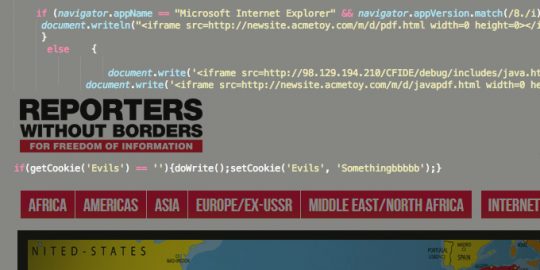
The Java saga continued when unknown, and apparently well concealed goons exploited recent Java and Internet Explorer zero-days to compromise the website of the French-based, free-press advocacy group, Reporters Without Borders. The attack, which attempted to take advantage of the time-gulf that separates Oracle’s patch release from their users’ application of it, is part of a watering hole campaign also targeting Tibetan and Uygur human rights groups as well as Hong Kong and Taiwanese political parties and other non-governmental organizations.

It’s really starting to feel like we’re piling on the perennially vulnerable, industry punching bag that is Java. That said, GFI Labs and other security firms are warning their users to be wary of malicious fake Java updaters taking advantage of all the patches Oracle had to ship last week.

Every time a story emerges up about malware popping up on an industrial control system or someone remotely hacking into some piece of critical infrastructure, there is a reliable and justifiable chorus of experts wagging their fingers and asking, “Why in the world was that system connected to the Internet in the first place?” At this point, pretty much everyone agrees that sensitive control systems should be air-gapped, or completely disconnected from the Internet. In this way, physical, human interaction should be the only way to access such systems, which is a considerable problem for those in the business of conducting cyberwarfare.