Dennis Fisher

About

Dennis Fisher is a journalist with more than 13 years of experience covering information security.

It is Time for Obama to Move on Cybersecurity Job

In his short time in office, Barack Obama has moved swiftly to address many of the problems facing the country: the financial crisis, the impending death of the auto industry and the lack of a playoff system in college football. But, despite his reassurances at a press conference in May, Obama has been stuck in neutral on the issue of cybersecurity.


Security Guard Allegedly Hacked Patient Records, HVAC System at Hospital

From DarkReading (Kelly Jackson Higgins)
A former security guard for a Dallas hospital has been arrested by federal authorities for allegedly breaking into the facility’s HVAC and confidential patient information computer systems. In a bizarre twist, he posted videos of his hacks on YouTube, and was trying to recruit other hackers to help him wage a massive DDoS attack on July 4 — one day after his planned last day on the job. Read the full story [DarkReading].

VMware Fixes Kerberos Flaw in ESX

VMware has released a patch for a serious flaw in the company’s flagship ESX software, which could enable an attacker to cause a denial of service or run arbitrary code on a vulnerable server. The flaw lies in the Kerberos authentication protocol, which is included in ESX, but is not enabled by default.


From Wired (David Kravets)
A federal appeals court, in the first decision of its kind, said Thursday that companies providing malware, spyware and adware blocking services are immunized by the Communications Decency Act of 1996 from lawsuits claiming unfair business practices.
A three-judge panel of the 9th U.S. Circuit Court of Appeals found that the CDA treats security software makers the same as internet service providers when they block material they find objectionable, granting them so-called “good Samaritan” immunity from civil lawsuits.  Like an ISP, such companies provide an “interactive computer service”  because they pull updates from a central server, the San Francisco-based appeals court said. Read the full story [Wired.com].

From SANS AppSec Street Fighter Blog (Jason Montgomery)
I just ran across Jakob Nielsen’s Alert Box post titled Stop Password Masking and wanted to provide some feedback from a security vs. usability perspective. I have great respect for Nielsen’s contribution to the usability of the web. Back in the early days of the internet (mid 1990’s), his books were gospel at my consulting firm, ATGi.
My initial reaction to his article was ‘that’s a crazy idea’ – but after some reflection, I really felt like it was a good mental exercise to actually consider what he was saying. If I hadn’t known who Nielson was, I probably would have dismissed his suggestion outright. Sometimes it is a good exercise to go back and review why we do the things we do – especially as it relates to information security controls. Nielsen questions the real security benefit of password masking – something I haven’t given a second thought to…well, ever. Read the full story [SANS].

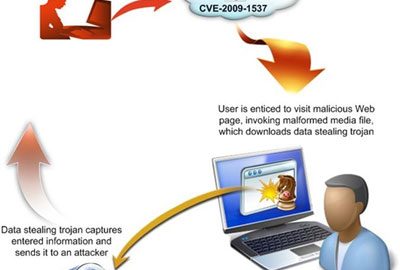
On May 28, our colleagues at The Microsoft Security Response Center released advisory 971778 which elaborated on a new vulnerability in Microsoft DirectShow effecting Windows 2000, Windows XP and Windows Server 2003. You can obtain more details on how to protect your environment from this vulnerability from the Microsoft SRD blog.
We have been closely monitoring the malware landscape for threats related  to leveraging exploits against this new vulnerability. We subsequently developed and released a generic detection for malformed media files, Exploit:Win32/CVE-2009-1537, based on MAPP information provided to us. Also, we have developed detections for the known malicious web pages, as Exploit:JS/Mult.BM or Trojan:HTML/Redirector.I. Our security products, such as Windows Live OneCare, Microsoft Security Essentials, and Forefront Client Security can block access to these malformed media files with signature definition update version 1.59.798 or higher. Read the full story [Microsoft Malware Protection Center].

From The New York Times (Thom Shanker)
Defense Secretary Robert M. Gates on Tuesday ordered the creation of the military’s first headquarters designed to coordinate Pentagon efforts in the emerging battlefield of cyberspace and computer-network security, officials said. Read the full story [NYTimes.com].