Dennis Fisher

About

Dennis Fisher is a journalist with more than 13 years of experience covering information security.

How the RSA Attackers Swung and Missed at Lockheed Martin

SAN JUAN, PUERTO RICO–The attack that resulted in the compromise of RSA’s SecurID database in 2011 had a lot of ramifications and sent shockwaves through much of the security industry. But it could have had much broader consequences had the security team at Lockheed Martin not discovered the same attack team on its own network and taken actions to shut them down.


Dotcom Offers €10,000 Reward For Breaking Mega’s Crypto

Of all the problems that entrepreneur Kim Dotcom has faced in the last decade, including several arrests, insider trading charges and even a raid on his New Zealand home involving black helicopters and dozens of agents in body armor, the criticism of the cryptography employed by his new Mega cloud-storage service would seem to be fairly low on the list. However, Dotcom is taking that criticism rather personally, if the €10,000 reward he’s offering to anyone who can break the service’s crypto is any indication.

China, The New York Times and the Value of Self-Shaming

There aren’t many things that count as surprises anymore in the security industry. And the news today that The New York Times was penetrated by a team of Chinese attackers who apparently had access to large amounts of employee emails for several months certainly doesn’t fall into that category. It would be news if these attackers weren’t targeting The Times and other large media companies. What’s interesting and novel is that the company decided to out itself as a victim, signing up for what may be a large dose of public scorn and derisive laughter.


NEW YORK–The long list of high-profile cyberespionage and cybercrime attacks that have surfaced in the last couple of years has led to broad discussions in the security community, government circles and elsewhere about the scope of the problem. Those discussions now are just starting to reach into the boardroom, and security experts say that any CEO who isn’t concerned about this problem is living in the past.

As the Senate pushes for legislation to improve information-sharing on threats and attacks and President Barack Obama prepares to issue an executive order on cybersecurity, the Department of Defense is looking for a massive increase in the number of trained cybersecurity personnel helping to defend the country’s private and public networks.

There is no shortage of problems for President Obama and the new Congress to tackle as they settle into their offices in Washington, D.C., this week, and one of the topics that’s at the top of that list is cybersecurity. Earlier this week a group of Democratic senators introduced a new cybersecurity bill, and now Janet Napolitano, secretary of the Department of Homeland Security, is taking to the stump, saying that new legislation is required to prevent a “cyber 9/11.”

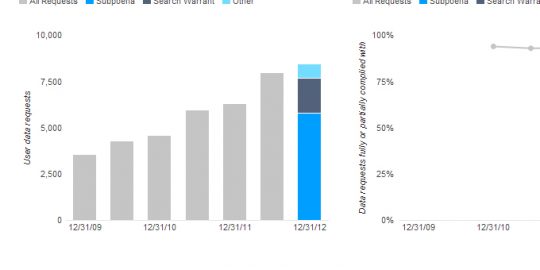
Google received more than 8,000 requests for user data from the U.S. government in the second half of 2012, and nearly all of them were the result of a subpoena or search warrant. The number of those requests that the company complied with by producing some or all of the data in question is still relatively high, at 88 percent, but declined slightly from the first half of last year.

The networks of government agencies and the military are under constant attack from a variety of sources, and the U.S., like most other countries, relies on those networks to not just run daily operations, but to support missions around the world. In the face of those attacks, the Department of Defense’s advanced research group, DARPA, is looking for new technologies that can collect and analyze massive amounts of network data and enable security teams to get quick reads on attacks happening across a broad, department-level network.