Government


Eugene Kaspersky: Clear Need to Define Cyberweapons and Cyberwar

The term cyberwar has become a catch-all used by politicians, talking heads and others to encompass just about any online threat, regardless of the attacker or the target. Among security professionals, however, the word has a specific connotation–an attack by one nation against another nation’s infrastructure. Aside from the semantic issues, one of the major challenges for government agencies and security teams dealing with his problem is attribution and recognizing what constitutes an actual act of cyberwar. Stuxnet, Flame and their cousins may qualify, but more discussion is needed to help define the terms of these new conflicts, experts say.


Gary McGraw on Cyberwar and the Folly of Hoarding Cyber-Rocks

Dennis Fisher talks with Gary McGraw of Cigital about some of the holes in the current thinking about cyberwar, why traditional military analogies don’t hold up in cyberwar discussions and how better defense can make a difference. McGraw will be discussing his thoughts on cyberwar at King’s College London this week.

A Sample Security Agenda for Obama’s Second Term

When Barack Obama was sworn in four years ago for his first term, there was genuine optimism that he would make meaningful improvements to the security of the nation’s critical infrastructure as well as the policies that govern security and privacy in the private sector. After the Bush administration relegated security to afterthought status for much of the 2000s as it concentrated on terrorism and fighting two wars, many in the security community were hopeful things would soon get better. Things certainly have changed, but whether they’ve improved is a difficult question. With Obama’s second term about to begin, there are still plenty of things he can do to effect real change.


Data breaches have become so common at this point that the mere fact that a government agency such as the South Carolina Department of Revenue loses several million Social Security numbers and credit card numbers isn’t really that noteworthy. It’s another day in the life of the Internet. But what is remarkable is that there are organizations out there that are not deploying encryption technologies to protect personally identifiable information because it’s complicated. Really?

The FBI says it is now making a push to not just stop cybercrime but to identify the attackers behind the phishing, credit card fraud and other campaigns that cost consumers and enterprises billions of dollars each year. The bureau is the lead agency charged with addressing cybercrime in the U.S. and has a large division dedicated to the problem, but it mostly has been concerned with stopping ongoing attacks rather than tracking down the criminals themselves. That appears to be changing.

A Southern California judge has rejected several key claims in a class-action lawsuit filed in response to Sony’s handling last year of a data breach that left millions of users at risk.In a ruling released by Courthousenews.com, U.S. District Court Judge Anthony Battaglia ruled users did not have an expectation of “perfect security” when they signed on with the company’s PlayStation Network.

Scared is a strong word, but the reality, according to a Websense analysis by Patrik Runald, is that spear-phishers, like the ones that compromised a White House network last week, are implementing new evasion tactics, fundamentally changing their attack strategies, and revolutionizing the targeted threat model, giving business executives plenty of reason to worry.

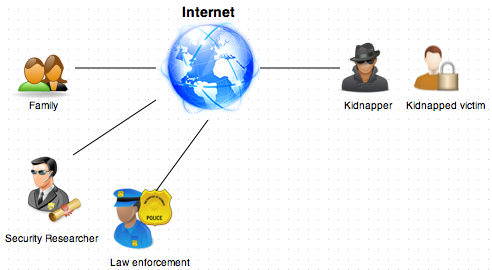
It can happen to anyone…and when it does it usually catches everybody – the victim and his relatives – completely unprepared. I’m talking about kidnapping. Twice in my life I’ve been involved in helping the police track down and arrest gangs of kidnappers. The first case didn’t directly affect me or my family, but the second time a close friend of mine was kidnapped. And it turns out that our work in tackling cybercrime can also be useful to catch criminals who seem to have little connection with high-tech wrong-doing.