Web Security


Google Blocks High Profile Sites After Advertising Provider NetSeer is Hacked

Google Chrome users, among others, couldn’t access some of the most popular Web sites Monday after an advertising network’s corporate Web site was injected with malware. But, according to the ad company’s chief executive, those sites were safe.Those who called up sites such as The Huffington Post, New York Times, Los Angeles Times, Washington Post and many other media sites, among others, were greeted with a warning that the sites contained malware.


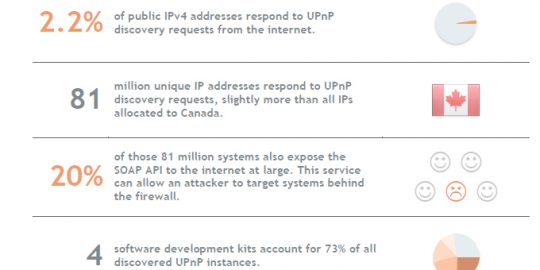
In a project that found more than 80 million unique IP addresses responding to Universal Plug and Play (UPnP) discovery requests, researchers at Rapid7 were shocked to find that somewhere between 40 and 50 million of those are vulnerable to at least one of three known attacks.

A vulnerability exists in Ruby on Rails’ JavaScript Object Notation (JSON) code that could open the Web framework up to a slew of security problems. Patches were published yesterday, but if left unpatched, the vulnerability could let attackers bypass authentication systems, inject arbitrary SQL code, inject and execute arbitrary code and perform a denial of service attack on a Ruby on Rails app.

Search giant Google is planning a third iteration of its vulnerability-finding contest, Pwnium. This year’s competition is set to be held alongside next month’s CanSecWest security conference on March 7 in Vancouver, BC. Unlike last year’s inaugural Pwnium, which was parallel to CanSecWest’s older Pwn2Own competition, this year Google teamed up with HP’s Zero Day Initiative, the group behind Pwn2Own, to work on the contest’s outlines and “underwrite a portion of the winnings.”

WordPress pushed out version 3.5.1 of its open source blogging platform yesterday, fixing 37 bugs including several cross-site scripting (XSS) errors and a vulnerability that could have allowed an attacker to expose information and compromise an unpatched site.

Researchers with Vulnerability Lab today announced mega payment processor PayPal has fixed a flaw on its site that allowed a remote user or a local user with low privileges to compromise a Web application using a blind SQL injection.The vulnerability was first reported to PayPal back in August, according to Softpedia, but the company waited until now to announce a fix. PayPal awarded the researchers a $3,000 bounty for responsibly disclosing their find.

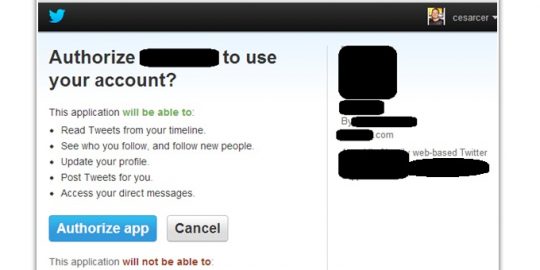
Social networking sites such as Twitter and Facebook have become not just communication hubs, but also authentication mechanisms for third-party sites. Many sites and Web applications allow users to sign in with their Facebook or Twitter credentials rather than registering, which is a nice convenience. That is, until, it turns into a security liability. Security researcher Cesar Cerrudo recently discovered a bug in Twitter’s code that enabled third-party apps to access users’ private direct messages under some circumstances, even when users had not explicitly granted those apps that level of access.