Vulnerabilities


Demo: Exploiting the Microsoft MsVidCtl DirectShow Flaw

By Georg Wicherski, Kaspersky Lab Germany

As you’ve probably already heard, there’s a dangerous vulnerability in Internet Explorer 6 & Internet Explorer 7 being exploited in the wild. The vulnerability affects Windows XP Service Pack 0 to Service Pack 2. Microsoft hasn’t released a patch yet, but they have provided a work-around. Some people have simply recommended turning off JavaScript to mitigate this issue. However this vulnerability is a trivial buffer overflow which makes it possible to overwrite the SEH handler. Thus, heap spraying is not required and turning off JavaScript only mitigates attacks from less skilled attackers.

How to Protect Against the MSVidCtl Vulnerability

The ongoing exploitation of the vulnerability in an ActiveX control used by Internet Explorer has created a dangerous situation, as there is no patch yet for the MSVidCtl.dll vulnerability. However, there are several steps you can take to protect yourself against attacks.


From The H Security
Symbian, found in many mobile phones, especially those from Nokia, is one of the most widely used mobile operating systems and has now been in use for more than ten years. It continues to be viewed as a very secure operating system, with special security functions and a certification system which help to ensure that only signed code can run with high privileges. Anti-virus vendors occasionally report new malware capable of running on the Symbian platform, but so far none have managed to spread widely. Read the full story [The H Security].

From IDG News Service (Sumner Lemon)
Apple is working to fix an iPhone vulnerability that could allow an attacker to remotely install and run unsigned software code with root access to the phone.
The attack in question exploits a weakness in the way iPhones handle text messages received via SMS (Short Message Service), said security researcher Charlie Miller, during a presentation at the SyScan conference in Singapore on Thursday. He didn’t provide a detailed description of the SMS vulnerability, citing an agreement with Apple. Read the full story [Yahoo News].

VMware has released a patch for a serious flaw in the company’s flagship ESX software, which could enable an attacker to cause a denial of service or run arbitrary code on a vulnerable server. The flaw lies in the Kerberos authentication protocol, which is included in ESX, but is not enabled by default.

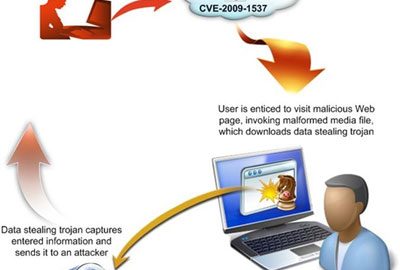
On May 28, our colleagues at The Microsoft Security Response Center released advisory 971778 which elaborated on a new vulnerability in Microsoft DirectShow effecting Windows 2000, Windows XP and Windows Server 2003. You can obtain more details on how to protect your environment from this vulnerability from the Microsoft SRD blog.
We have been closely monitoring the malware landscape for threats related  to leveraging exploits against this new vulnerability. We subsequently developed and released a generic detection for malformed media files, Exploit:Win32/CVE-2009-1537, based on MAPP information provided to us. Also, we have developed detections for the known malicious web pages, as Exploit:JS/Mult.BM or Trojan:HTML/Redirector.I. Our security products, such as Windows Live OneCare, Microsoft Security Essentials, and Forefront Client Security can block access to these malformed media files with signature definition update version 1.59.798 or higher. Read the full story [Microsoft Malware Protection Center].

From CERT (Will Dormann)

Two recent US-CERT Vulnerability Notes [cert.org] describe similar issues in the Adobe Reader and Foxit Reader PDF viewing applications. The vulnerabilities, that both applications failed to properly handle JPEG2000 (JPX) data streams, were discovered as part of our Vulnerability Discovery initiative. The two vulnerability notes are quite similar, except for one aspect: attack surface.  Read the full blog post [cert.org]